

17 Million Barrels or Five Ships?

Something strange is happening in the Strait of Hormuz, and the numbers don’t quite add up.
On Monday, Aug. 31, U.S. Energy Secretary Chris Wright said more than 17 million barrels of crude passed through the Strait of Hormuz — the highest daily volume since the Iran war began. Even though that sounds reassuring, it also happens to be difficult to reconcile with commercial shipping data.
Kpler, which tracks vessel movements worldwide, counted five vessels through the Strait that Monday against a 10-day average of roughly 14 — none a liquid tanker. Traffic stayed thin after: 11 crossings Tuesday, Sept. 1, and six Wednesday, Sept. 2.
Kpler notes the caveat: vessels that turn off their transponders — the maritime equivalent of “don’t look at me” — don’t appear in its count. Nor do ship-to-ship transfers.
Five visible ships cannot, alone, prove that 17 million barrels did not move. There is a duller explanation, probably the right one: the two sides count different things. A U.S. tally plausibly includes everything moving under naval protection — auxiliaries, tugs, dhows — which Kpler filters out on size or cargo grounds. Not one number in dispute. Two questions answered at once.
But that’s the problem: the evidence is unusually hard to verify without a submarine and a search warrant.
At a Glance: The 17-Million-Barrel Gap
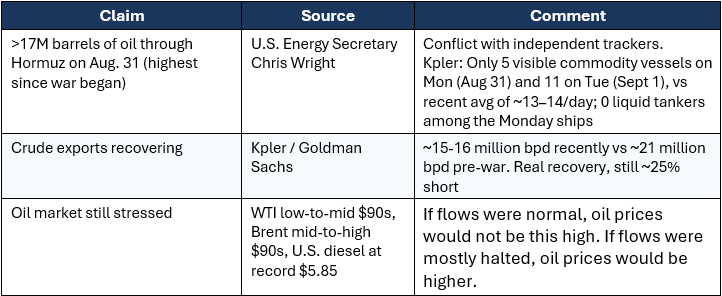
Note: Kpler acknowledges its data can miss dark vessels (AIS off) and ship-to-ship transfers. The gap between the U.S. claim and visible tracker data remains difficult to independently verify.
The Market Seems to be Splitting the Difference
WTI has been trading in the low- to mid- $90s and Brent in the mid- to high-$90s. U.S. diesel hit a record $5.85 per gallon last week.
If the market believed Middle East exports had returned to normal, you’d expect far less stress in prices.
Instead, it’s saying something more nuanced: oil is getting through, a lot of it, but the system is nowhere near normal. Normal left the chat months ago and isn’t returning our text messages.
That distinction matters for North American producers.
Meanwhile, in Alberta (Where the Oil Doesn’t Need an Escort)
The obvious beneficiaries are Canada’s oil-sands producers.
Their economics are misunderstood because costs look higher than Middle Eastern barrels. But the question isn’t whether Alberta produces oil for $10.
It’s whether these companies can generate substantial free cash flow when oil is at $70, $80 or $90.
The answer is increasingly yes.
Cenovus Energy (CVE) recently cut its 2026 oil-sands operating-cost guidance to roughly $10.75–$11.75 per BOE (barrel of oil equivalent). Canadian Natural puts its corporate WTI breakeven — sustaining capital and dividends included — in the low-to-mid $40s.
That creates a beautiful asymmetry.
If Hormuz normalizes, Canadian producers don’t become bad businesses — they just operate at lower prices.
If it persists, every extra dollar of crude flows disproportionately to producers with long-life reserves and low sustaining costs.
Canada also has what it lacked before Trans Mountain’s 2024 expansion: real access to the Pacific.
Trans Mountain moves about 890,000 barrels a day, and in June it ran full for the first time since the expansion. Asian refiners suddenly care a lot more about supply that doesn’t need a U.S. Navy babysitter.
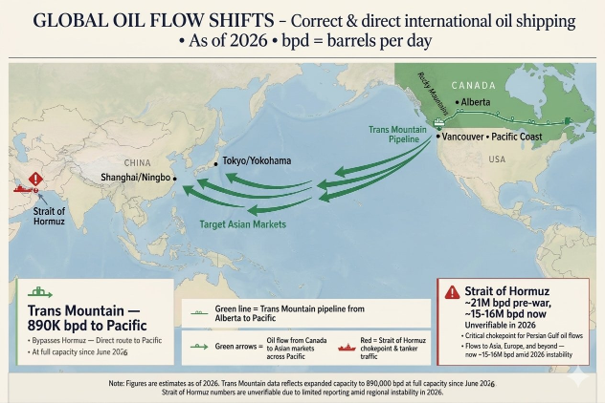
That is strategically important.
Canadian output should top its 2025 record of roughly 5.3 million barrels a day this year — more barrels meeting a market with a new appreciation for supply security.
The war created a new class of buyer: Asian refiners unwilling to hang their supply chain on one vulnerable chokepoint. Why not U.S. shale, which also avoids the strait? Because barrels aren’t interchangeable. Gulf crude is medium sour, Canadian is heavy sour, U.S. shale is light sweet — and a refinery built to run Basrah can’t swap in Permian light. Canadian heavy is the closer substitute for what Hormuz stopped delivering, which is why Trans Mountain filled while U.S. export capacity had room. Canadian producers also earn twice: on crude, and on the WCS discount Trans Mountain narrowed. Not a better business — a closer substitute.
Which Canadian Oil Stock?
Four names are worth considering: Canadian Natural Resources (CNQ), Suncor Energy (SU), Cenovus, and Imperial Oil (IMO). They aren’t interchangeable. My valuation work favors CNQ. I’m going with Suncor Energy anyway.
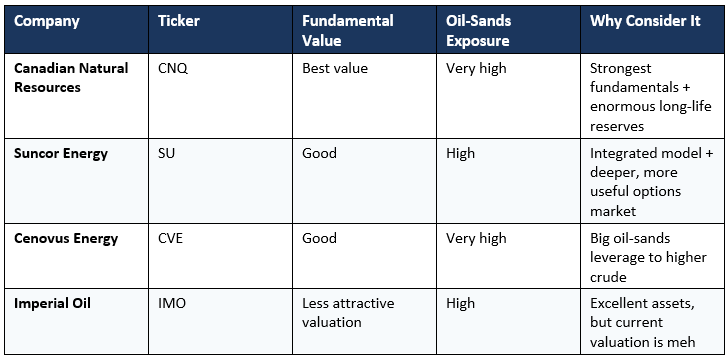
Not because Suncor is the better company — because SU has the more liquid options market, which matters when the objective is a defined-risk trade rather than owning stock.
That’s an important distinction. The best company and the best options vehicle aren’t always the same thing.
Managing the Risk (Because Geopolitics Loves Plot Twists)
There is a temptation here to simply buy Suncor and wait for higher oil prices.
I don’t love it. Geopolitical trades are hard to time, and a cease-fire or policy shift could knock $10 or $15 off crude in a hurry.
Buying the stock and praying for higher oil is the financial equivalent of texting your ex “wyd,” for “What you doing?”
So, I’d rather define the risk.
Bull Put Spread on Suncor (SU) — Defined-Risk Setup:
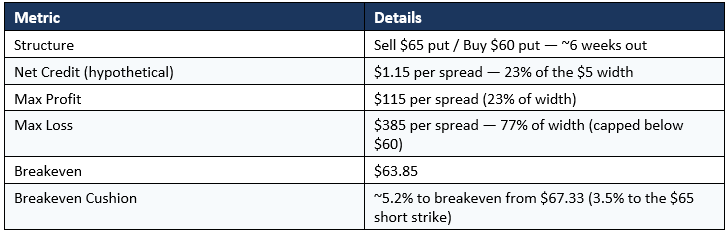
Suncor doesn’t have to go up for this to work. It can decline just over 5% and still profit at expiration, provided it stays above the $63.85 breakeven.
And if Suncor collapses below $60, the loss is capped at $385 per spread.
That’s the attraction. We aren’t predicting where oil trades next month — only that Suncor stays above a defined price.
Option Trades Can Win Even When You Don’t Have a Clue
Oil doesn’t have to pass through Hormuz to make Suncor valuable.
It owns long-life reserves in a stable country, refining that cushions falling crude, and Pacific access that barely existed two years ago.
The uncertainty creates the opportunity; the trade doesn’t require me to predict how the story ends.
Beyond Suncor: Where I’m Finding the Real Opportunities
Hormuz is confusing because its biggest variable is two spreadsheets that won’t speak to each other. I like the structure of this trade far more than the certainty behind it — that’s the trouble with headline trades. You end up sizing around somebody’s satellite feed and a prayer.
My Options for Income subscribers get weekly defined-risk trades on companies whose earnings don’t depend on whether a shipping lane is having a mood. Same structure, with specific strikes, expirations and an exit plan — without refereeing anyone’s data.
If you’d rather trade the best opportunities the market offers instead of settling for the ones that happen to be in the news, click here to join Options for Income today.
Note from the Publisher:
Roger Michalski here. Please join me Sept. 16 at 2 p.m. Eastern when I’ll host an important online panel discussion on The 5 Factors Directing the Market in Q4. I’ll be joined by Eagle experts George Gilder, Jim Woods, Bryan Perry, Jim Fink, and Bob Carlson. Not only will we discuss the 5 factors and how they affect the market, but each of them will also share their #1 play for Q4. For more info, click here now.
Share Your Success Story:
Did one of Jim Fink’s recent trades work out well for you? We’d love to hear the story. Send a quick note to mysuccess@jimfinkinvesting.com and tell us how the trade went. Thanks!
Leave a Reply
You must be logged in to post a comment.
Search Jim Fink Investing
Log In
Forgot Password