
Japan Has a Word for Anthropic’s IPO

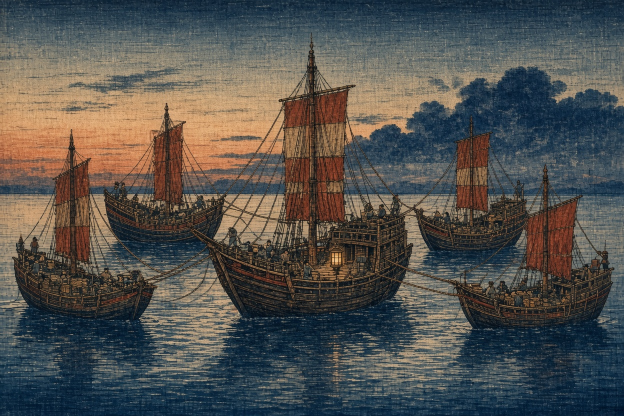
Owners, suppliers, lenders, distributors: the same few companies, tied together.
Anthropic lost $104.0 billion in the first nine months of 2026 and finished September with $131.8 billion in cash and short-term investments, up from $20.3 billion. Both numbers come from the company’s amended S-1 filed Nov. 2 for a Nasdaq listing under the ticker ANT. Most of the loss, $94.3 billion, is an accounting charge for the rising value of financing that converts into stock.
Most of the cash came from investors: $110.7 billion, nearly all of it in the first half. It takes a special kind of company to lose $104 billion and still need additional cash.
The business underneath is real, and so is its appetite. Third-quarter revenue was $17.0 billion, up from $1.4 billion a year earlier. Anthropic also swung from a $974 million operating profit in the second quarter to a $567 million loss, as compute spending jumped 77% to $9.9 billion, including $5 billion of pricey short-term capacity. A $2 billion non-cash donation charge also hit the quarter. A bubble caller gets little help from the revenue line and a bit more from the cost line.
The harder question is who is paying whom. The answer is mostly the same handful of companies, showing up in one role after another, like a small-town musical where the mayor plays the lead, runs the box office and financed the sets.
Follow the IOUs
Anthropic’s biggest shareholders are also its biggest suppliers and sales channels. Amazon.com (NASDAQ: AMZN) owns a stake, sells Claude through Bedrock and supplies computing capacity, and Anthropic must spend at least $110 billion with it through April 2036. Google parent Alphabet (NASDAQ: GOOGL) owns a stake and supplies TPU chips, with at least $121.3 billion of Anthropic spending committed through July 2033. Microsoft (NASDAQ: MSFT) adds $44.9 billion. Cloud marketplaces were 44% of nine-month revenue.
The suppliers are also lined up to lend. As of Sept. 30, all three new facilities were undrawn. If you can follow this table on one pass, you should be writing this column.
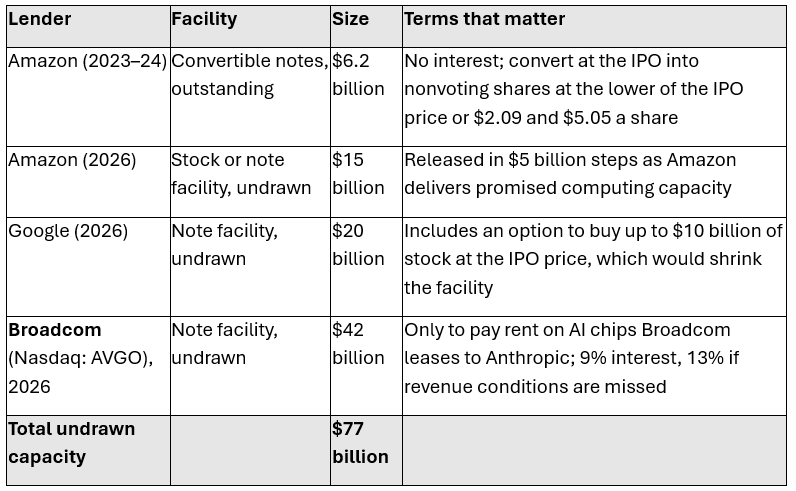
Broadcom’s (NASDAQ: AVGO) facility is the cleanest example. Anthropic owes about $161.2 billion of rent on five-year Broadcom chip leases, and it can borrow up to $42 billion from Broadcom or a partner it designates to pay rent under the March 2026 lease. The notes convert into stock at a discount, and if Anthropic is ever sold, Broadcom can take 150% of what it is owed in cash. Those are a careful lender’s terms on a supplier financing its own sale: the car dealer who sells you the car, lends you the payments and keeps a close eye on the driveway.
Amazon’s new money arrives only as it delivers promised computing capacity. Its older notes pay no interest and convert upon the IPO at $2.09 and $5.05 a share, the valuations of two and three years ago.
Nvidia (NASDAQ: NVDA) is not in the table, mostly because it is busy sitting at everyone else’s. It is reportedly in talks to anchor the offering with up to $10 billion.
Turning Japanese
The Vapors had a hit with “Turning Japanese” in 1980. Silicon Valley is working on the cover version. Japan’s postwar keiretsu were webs of companies that owned pieces of one another, bought from one another and, through a main bank, lent to one another. At its best, the arrangement gave Japanese industry patient capital and gave suppliers to Toyota Motor (NYSE: TM) the security to invest for decades.
At its worst, it shielded weak managers from outside shareholders, and in the 1990s it kept banks lending to failing partners rather than booking the losses. When Japanese stocks peaked in 1989, the losses traveled through each web together, because many balance sheets held their partners’ shares. Anthropic’s filing describes its own version: a default under certain commercial agreements could speed up repayment of substantially all its debt and set off a “cascading series of adverse consequences.”
The fit is not exact. A keiretsu ran on group loyalty, and Anthropic takes money from Amazon, Google and Microsoft at once, while Nvidia plays main bank to nearly everyone. Google is simultaneously investor, supplier, lender and competitor, which would have confused even a Mitsubishi executive.
The feedback loop is the part that matches. In the first quarter, Alphabet booked about $28.7 billion in gains tied to its Anthropic stake, nearly half its net income, and Amazon booked $16.8 billion pre-tax, Fortune reported. Those gains are fair-value marks, driven largely by Anthropic’s share sales at higher prices, and Anthropic spends much of that money on the same companies’ cloud capacity. Anthropic raised essentially no net new money in the third quarter, and the windfall went quiet: Amazon’s total other income, which doesn’t isolate Anthropic, was a $703 million loss. The listing will turn those marks into a public price, which makes the IPO a test of the suppliers’ earnings, too.
Lucent’s $8.1 Billion Lesson
Around 2000, Lucent and Nortel lent billions to telecom startups so they could buy their equipment. Lucent’s commitments reached $8.1 billion, about $15.7 billion in today’s dollars and roughly three-eighths of the single Broadcom facility. When the customers failed, Lucent booked a $2.2 billion provision for bad debts and customer financings in fiscal 2001.
Lucent’s borrowers had little revenue, and Anthropic will not run out of money next year. What it faces is a mismatch between costs that are fixed and revenue that is not. The S-1 puts commitments at about $895.4 billion, mostly for compute and infrastructure and roughly half of it by 2030, though $213.8 billion is subject to termination rights or conditions. About $69.8 billion comes due within 12 months, roughly third-quarter revenue times four. Against that, customers have contractually committed to $13.8 billion of future revenue, 79% of nine-month revenue was consumption-based, and many large customers can cut or stop spending. Anthropic estimates 5% to 7% of nine-month revenue came from customers violating its usage rules or commercial terms.
Rivals can speed that up. On Nov. 2, ADNOC, the United Arab Emirates’ state oil company, said it will deploy OpenAI’s Frontier platform. No financial terms were disclosed.
Growth is already slowing in dollar terms. Anthropic added about $5.4 billion of revenue in the third quarter, on unaudited figures, against about $6.8 billion in the second quarter.
The risk sorts itself by layer. Leveraged neoclouds such as CoreWeave (NASDAQ: CRWV) and Nebius Group (NASDAQ: NBIS) carry the most default risk. Suppliers concentrated in AI, Nvidia and Broadcom, carry the most risk of a valuation reset. Anthropic sits in between, with the cash to survive a slowdown and obligations that assume one never comes. Amazon and Google carry the least, because their AI exposure sits on businesses that would survive without it, though their shares can still get hit for the bill. Amazon’s free cash flow was negative $42.4 billion over the trailing 12 months, despite $168.3 billion of operating cash flow. S&P Global (NYSE: SPGI) drew a similar line on Oct. 30, cutting its outlook on Meta Platforms (NASDAQ: META) to negative and calling its ability to monetize AI “more limited than that of its peers.”
Why Amazon?
A put credit spread needs a stock that avoids a sharp drop over the next several weeks, and the main event in that window is Anthropic’s pricing. A bad deal would sting, but nobody cancels Prime over an IPO. Amazon earns money selling compute and distributing Claude. Its older notes convert at prices set years ago, so much of its stake carries a large cushion, though its $5 billion May purchase came at a recent price. AWS sales grew 39% last quarter, and the stock fell just 1.4% to $240.35 after earnings on Oct. 30.
The Trade: Bullish Put Credit Spread on AMZN
Options rather than the stock, because the spread offers leverage at low cost and a high rate of return, without needing Amazon to rally.
A bullish put credit spread — sell a higher-strike put, buy a lower one for cover — wants three things: a stock you like, a premium fat enough to be worth the risk and a cushion between the current price and the strike you sell. Amazon offers the first and third. The premium depends on the market, so choose strikes by delta: sell the put near 20 delta, roughly a one-in-five chance of finishing below that strike, and buy the one about $10 below it.
Say AMZN is trading at $245. You sell the $230 put and buy the $220 put, both expiring Dec. 18. You collect $2.00 upfront, 20% of the $10 width, and that is the most you can make. Max loss is the $10 gap minus the credit, so $8.00, or 80% of the width. Breakeven is $228, about 7% below the current stock price.
The stock does not have to go up. It only has to finish above $230 on Dec. 18. Amazon can drift lower, sit still or rally, and the spread keeps the full credit.
Beyond Amazon: Where I’m Finding the Real Opportunities
This is a decent opportunity on a strong company with complicated ties, not a great one. My Options for Income subscribers get weekly defined-risk trades on stocks whose solid seasonals and strong business fundamentals don’t depend on a keiretsu web of complexity.
If you’d rather trade the best opportunities the market offers instead of settling for just average, click here to join Options for Income today.
Coming in Part 2: whether to buy Anthropic itself. I walk through the lockup schedule, the share count and the IPO research, and I propose a put credit spread on one of Anthropic’s chief competitors.
Note from the Publisher: Did one of Jim Fink’s recent trades work out well for you? We’d love to hear the story. Send a quick note to mysuccess@jimfinkinvesting.com and tell us how the trade went. Thanks!
P.S. The COSM Technology Summit will take place Nov. 18-20 at the Westin Kierland in Scottsdale, Arizona, featuring my associate and the event co-organizer George Gilder as a speaker. For more information about the conference and its speakers, visit https://cosm.tech/. To register, click here and use Promotion Code EAGLE-200 to receive a $200 discount.
Leave a Reply
You must be logged in to post a comment.
Search Jim Fink Investing
Log In
Forgot Password