

The $96 Million Chip-Call Post-Mortem

Did the option bets from Sept. 18 pay off on Oct. 2? Yes. Two of the four barely made it.
At 4 p.m. on Friday, Oct. 2, $96 million of chip-stock call options ran out of time. At the closing prices, they were worth $141.7 million, a 47% gain in two weeks. Micron’s blowout earnings report on Sept. 30th, the event the whole package was built around, had surprisingly little to do with it.
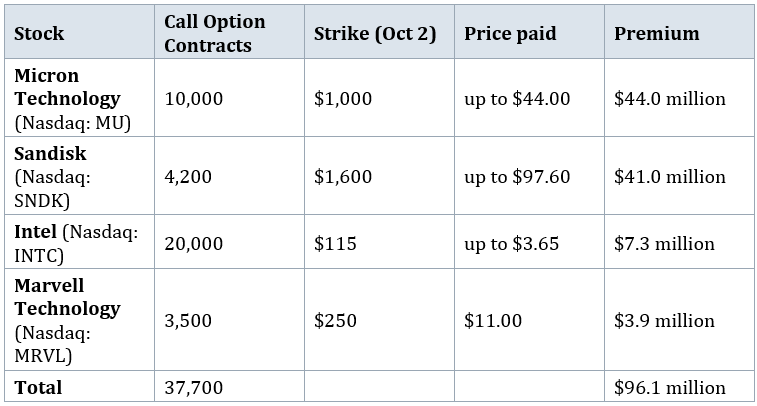
Sept. 18 opening package.
A single buyer placed all four trades on Sept. 18, quarterly expiration day. Jim Cramer guessed on X that it was Leopold Aschenbrenner’s Situational Awareness, the AI fund whose leveraged stock book was liquidated in July. The guess had a backstory. A week earlier, on Sept. 11, CNBC reported that the fund was back in the market buying longer-dated calls on Advanced Micro Devices (Nasdaq: AMD), Bloom Energy (NYSE: BE), CoreWeave (Nasdaq: CRWV), SK Hynix (Nasdaq: SKHY), SanDisk and the Roundhill Memory ETF (Cboe US: DRAM), trades placed in late August and early September.
The Sept. 18 package is a separate, short-dated bet: four chip names, all expiring Oct. 2. Micron and SanDisk took $85 million of the $96 million, and Micron reported after the close on Sept. 30, two days before expiration. That is a wager on one earnings report with a hard stop on the calendar.
The Report Was the Least of It
Micron delivered. Fiscal fourth-quarter revenue came in at $54.23 billion against a consensus near $50.45 billion, and adjusted earnings of $33.42 a share beat by about 7%. Options traders had priced a move of about 8% either way. Micron gave them a shrug. The stock slipped after hours, rose 3.03% on Oct. 1 to $1,097.39, then fell 2.05% on expiration day to $1,074.89.
Micron was already trading at $1,065 going into the earnings report on Sept. 30, so the money was made on the call options in the two weeks before it came out. The report itself added nothing: options priced an 8% move, and the stock delivered about 1%.
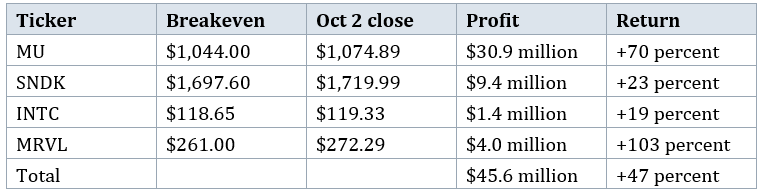
Oct. 2 scorecard. Breakeven = strike + price paid. Profit = (Oct. 2 close − breakeven) × 100 × contracts. My arithmetic.
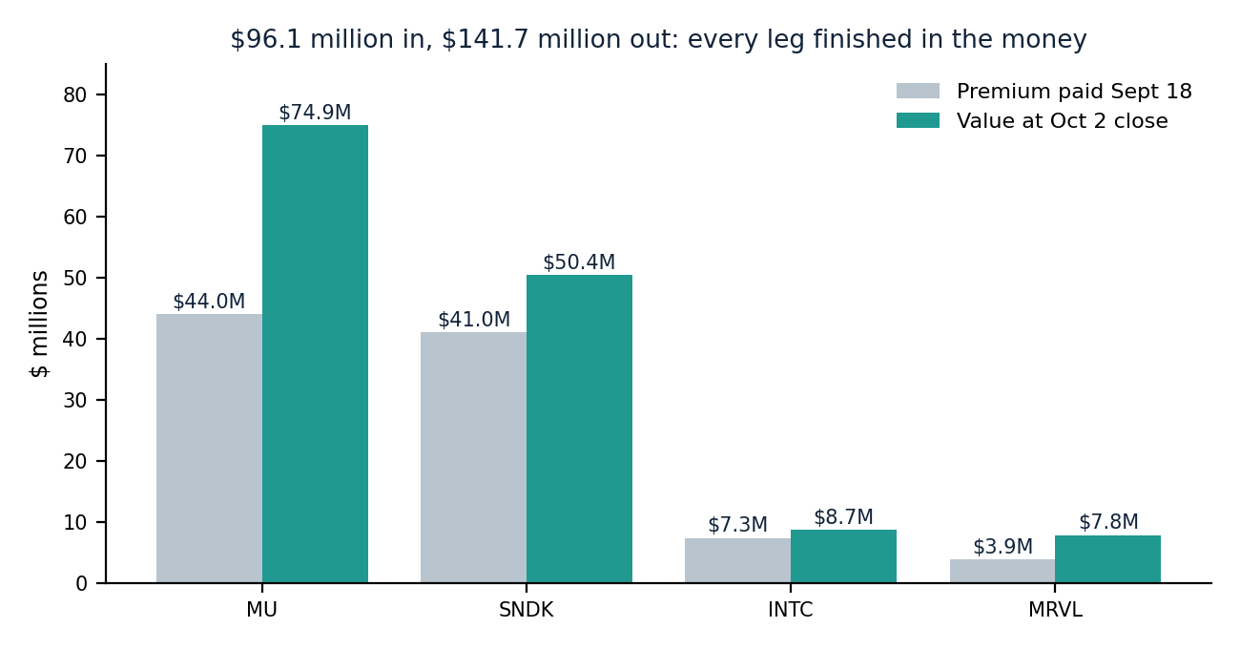
Every leg cleared breakeven, so the answer to the headline question is yes. The margins are less comfortable. Micron supplied $30.9 million of the $45.6 million. Intel finished 68 cents above breakeven. SanDisk, down 3.79% on expiration day, finished 1.3% above its breakeven. One more bad hour and the second-biggest leg would have lost money.
What Happened at 4 P.M.
In-the-money calls are exercised automatically at expiration, and exercising all four would have cost about $2 billion. The 10,000 Micron contracts alone cover 1 million shares at $1,000 apiece. A call buyer who doesn’t want $2 billion of stock sells the calls before the bell instead. Either way, the dealers’ hedge comes off.
For two weeks, dealers short those calls had been buying memory stocks to stay hedged. On Oct. 2 the support ended on schedule at market close.
How Following the Big Boys Can Help the Little Guy
You can piggyback on a smart trader’s bets. The Sept. 18 prints were public within hours, because Cramer posted them that morning. A reader who copied the Micron leg that day finished well ahead by Oct. 2. Copying the same fund’s leveraged stock book in July would have been a disaster. That’s one trade each way, so borrow the thesis and the calendar, size small, and limit what you can lose through options.
A call debit spread would have earned far more. Buying the $1,000 call and selling the $1,050 call against it would have cost about $22.40 instead of $44, cut breakeven to $1,022.40, and expired worth the full $50 spread width: a 123% gain against 70% for the bare call. The short call also cancels most of the time decay, so the spread gained value through Micron’s earnings report while the long call lost about $7.
A big call buyer is a calendar. Until options expiration, dealers hedging those big buyer’s calls are buying the stock, which props it up. That’s a poor time to bet against the stock. Once the calls expire, the support is gone, so watch the first trading sessions after expiration. A dip then may say more about the options calendar than about the company.
Take the gain before the earnings report. Micron cleared the $1,000 strike before it reported, so the September buyer already had the profit in hand. The options market priced about an 8% move for the report, which pumped up the calls’ time value, and the move that came was about 1%. Holding through the report is what cost the bare call that $7 in time value, roughly $7 million across 10,000 contracts. Meanwhile, an at-the-money 1065P/1065C straddle sold before the earnings report was released kept a large portion of its roughly $84.50 premium.
The Trade: Bullish Put Credit Spread — Micron or Broadcom (NASDAQ: AVGO)?
The September call buyer was betting on AI-chip demand. You can borrow that thesis without inheriting its calendar. A bullish put credit spread — sell a higher-strike put, buy a lower one for cover — wants three things: a stock you like, a fat-enough premium, and downside cushion under the current price.
The case for MU. Micron is in this story, just posted record revenue and has no report for about three months. But the hedging bid that propped it up through Oct. 2 is gone.
The case for AVGO. Broadcom offers the same AI-chip thesis. Morningstar rates it five stars with a $650 fair value, against an Oct. 20 close of $334.37, and its next report isn’t due until December. Nobody bought a pile of two-week Broadcom calls in September, so there’s no expired hedge to lose.
My take. AVGO. A put spread needs support under the stock, and Broadcom’s doesn’t depend on an options calendar that already ran out.
Say AVGO is trading at $334.37 like it was at market close on Oct. 20. You sell the $315 put, about a 29-delta strike, and buy the $310 put, both expiring Friday, Nov. 27. You collect $1.35, 27% of the $5 width, and that’s the most you can make: $135 per spread. Max loss is the width minus the credit, $3.65, or $365 per spread. AVGO doesn’t have to rally. It only has to stay above $315 at the Nov. 27 close, 5.8% below $334.37.
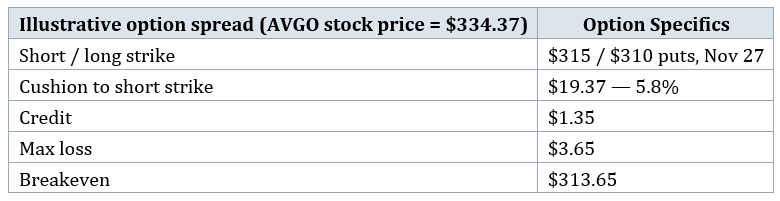
Credit from recent quotes; check a live chain before trading.
Beyond AVGO: Where I’m Finding the Real Opportunities
A $1.35-per-share credit on a 5.8% cushion is a decent opportunity, not a great one. My Options for Income subscribers get weekly defined-risk trades on stocks whose solid seasonals and strong business fundamentals don’t depend on artificial props like big call buyers and dealer hedges. It is the same options spread structure, with specific strikes, expirations and a downside cushion that maximizes the probability of success.
If you’d rather trade the best opportunities the market offers instead of settling for just average, click here to join Options for Income today.
Note from the Publisher: Did one of Jim Fink’s recent trades work out well for you? We’d love to hear the story. Send a quick note to mysuccess@jimfinkinvesting.com and tell us how the trade went. Thanks!
Leave a Reply
You must be logged in to post a comment.
Search Jim Fink Investing
Log In
Forgot Password