

Nobody Told the Data Centers

On Monday, Sept. 14, Intel (NASDAQ: INTC) fell 7%, Advanced Micro Devices (NASDAQ: AMD) fell 6%, Marvell Technology (NASDAQ: MRVL) fell 7%, Micron Technology (NASDAQ: MU) fell 4.7%, Broadcom (NASDAQ: AVGO) fell 4.4% and Nvidia (NASDAQ: NVDA) fell 3%. The cause was a weekend in which three artificial intelligence (AI) chief executives agreed that their industry should slow down.
Over the same Monday trading session, cybersecurity stocks Palo Alto Networks (NASDAQ: PANW), CrowdStrike Holdings (NASDAQ: CRWD) and Zscaler (NASDAQ: ZS) all rose in the neighborhood of 13-14%.
Look again at the ordering of those declines, because it is the most interesting thing that happened all day.
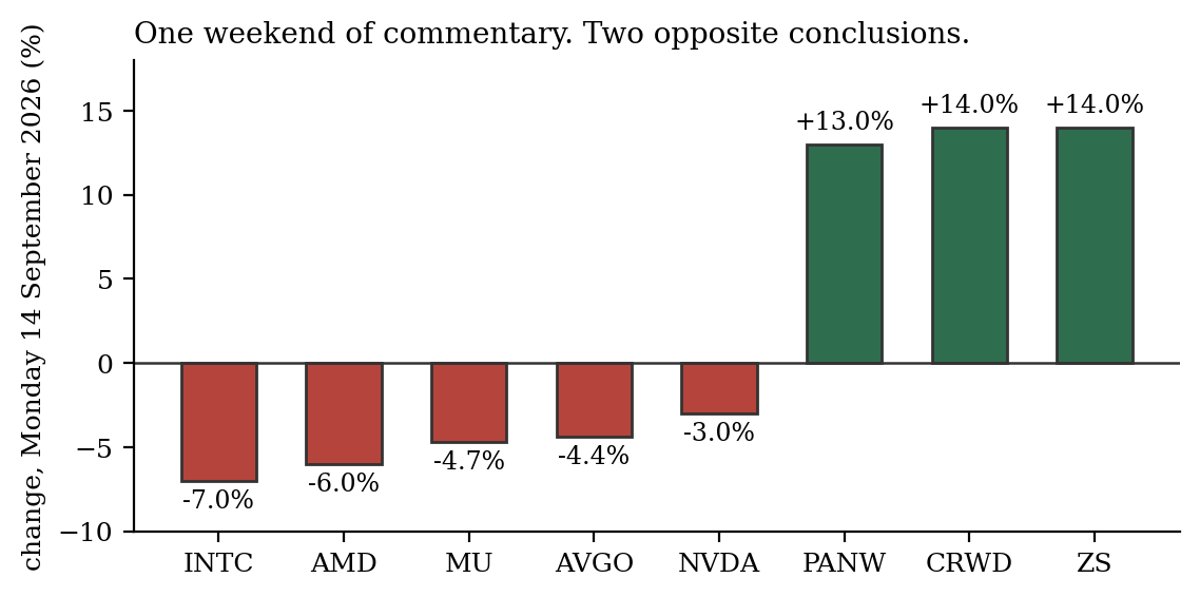
Monday, September 14, 2026. The security names bought the threat. The buildout names sold the slowdown.
What Was Actually Proposed
The cause of this semiconductor volatility was an essay written by Anthropic CEO Dario Amodei, which runs at about 3,800 words and contains one sentence that matters for anybody who owns semiconductors: we must slow the pace at which we improve the capabilities of AI models.
Note how narrow the thing he wants slowed actually is: the rate at which AI capabilities improve. Not deployment, not inference, not the selling of models that already exist — the essay simply doesn’t address them. Amodei states elsewhere that pacing does not mean halting model training or technical progress.
Consequently, I view the shift as one from extremely fast to only somewhat fast, and it doesn’t really matter for many AI stocks because there is already nowhere near enough computing power to satisfy demand for the AI models that exist today.
Training is the headline. Inference is the invoice. And the market, to its credit, knew the difference. It did not sell semiconductors indiscriminately on Monday. It sold them roughly in order of training exposure. Intel, AMD and Marvell — the accelerators and the cluster networking, where thousands of chips have to behave as one synchronous machine for weeks at a time, which is a training problem and very nearly only a training problem — fell 6-7%. Nvidia, Broadcom and Micron, whose revenue is split across training and inference, fell 3-4.7%. That is not a panic. That is a reasonably precise reading of the essay.
The argument is not that the market sold the wrong thing. On the training-levered names, it sold the right thing, and anyone buying AMD or Marvell here is betting the essay is wrong about training. Buying Broadcom or Micron only requires that the market overstated how much of their revenue depends on it. The argument is that the names whose demand is substantially deployment-driven got carried along in a sector-wide move, and that a 4.5% markdown is more than their mix warrants.
On Tuesday, Sept. 15, Meta Platforms (NASDAQ: META) CEO Mark Zuckerberg declined to join the coordinated slowdown party and offered a different commitment instead: the significant majority of Meta’s computing budget goes to serving people rather than racing toward recursive self-improvement. He named no percentage, so nobody can audit it. But it is the only public statement by any hyperscaler about where the chips actually go, and it points at inference.
Read that carefully — a hyperscaler committing most of its compute away from recursive self-improvement is explicitly bearish for frontier training demand — which is exactly what Monday priced, and priced correctly. What it supports is the other half: that the computing power not chasing the next frontier run is serving users on models that already exist, and that demand does not go away because the release calendar slows. Zuckerberg is evidence for the shape of the trade, not for the market having made a mistake.
Back in August, Elon Musk was even more explicit about the endpoint: “99% of compute long-term will be for inference.” The statement comes from someone currently building some of the largest training clusters on the planet, yet still insisting that the steady-state use of computing power in the future will overwhelmingly serve existing AI models, not train the next one.
What Did Not Change
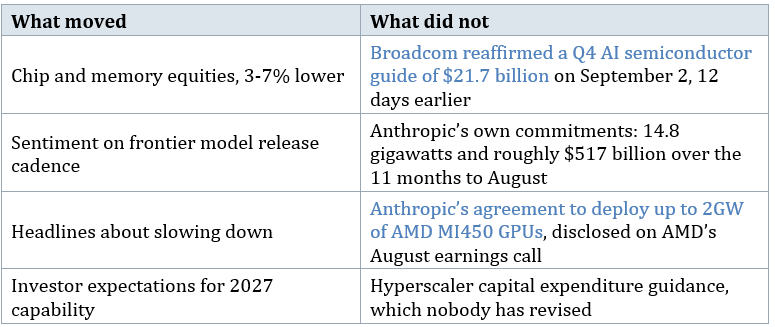
Anthropic, the company whose essay caused the selloff, is one of the larger buyers of the hardware that sold off!
The Case for Broadcom
Broadcom sold off 4.4% to roughly $345 on commentary that contradicts nothing in its own guidance, which it reaffirmed 12 days ago: $21.7 billion of AI semiconductor revenue guided for the fiscal fourth quarter, off third-quarter AI chip revenue of $16.7 billion, up 221% year over year. Its exposure is custom accelerators and networking for hyperscalers — spending governed by data center build schedules set years out, not by how quickly anyone releases the next model. It carries no China policy overhang in this particular news cycle.
The Case for Micron
Micron fell 4.7%, and the thesis is cleaner still: high-bandwidth memory is supply-constrained, and every deployed agent consumes it regardless of frontier cadence. If inference demand is the thing nobody can currently serve, memory is the binding constraint, and a pause in capability improvement does nothing to loosen it. The catch is that Micron is a memory company, which means it is a cyclical with a long history of violent drawdowns that have nothing whatever to do with AI.
My Take
In my opinion, the better play to take advantage of the unwarranted Monday selloff is Broadcom, and it is not because I consider Broadcom’s business better than AMD’s. For a put credit spread, you are underwriting the odds of a large drop, and what you want is the name where a downside surprise is least likely to arrive from somewhere you were not looking. Broadcom told the market what its next quarter looks like 12 days ago and has not retracted it. Micron has the purer thesis and the memory cycle sitting underneath it, which is precisely the kind of unpredictable thing that ruins a short put while you are busy being right about AI.
Say AVGO trades at $360. Sell the $330 put and buy the $320 put, roughly two months out to November options expiration. The spread is $10 wide. You collect $2.45, which is 24.5 percent of width, and that credit is the most you can make. Max loss is width minus credit, or $7.55, which is 75.5% of the spread width, for a 32.5% return on the $755 at risk per spread. Breakeven sits at $327.55, about 9.0% below the stock’s current price.
The stock does not need to rise and recover the gap from Monday, Sept. 14. It does not need to do anything. It only has to avoid falling through $330 by November expiration, and you are not underwater until $327.55. You are being paid for the distance between here and there, and time works for you every day it stays above.
Beyond AVGO: Where I’m Finding the Real Opportunities
My Options for Income subscribers get weekly defined-risk trades built on seasonality, fundamental valuation and the chart — not on a stock that fell 4% because a CEO published an essay on a Saturday. Same structure, with specific strikes, expirations and an exit plan, on setups I’d take whether or not the name was in Monday’s headlines.
If you’d rather trade on something more durable than a one-day overreaction, click here to join Options for Income today.
Note from the Publisher: Did one of Jim Fink’s recent trades work out well for you? We’d love to hear the story. Send a quick note to mysuccess@jimfinkinvesting.com and tell us how the trade went. Thanks!
Leave a Reply
You must be logged in to post a comment.
Search Jim Fink Investing
Log In
Forgot Password